Picture this: You just secured the
listing for a stunning mid-century modern home. The natural light in the living room is cinematic, the newly
renovated kitchen features imported quartz countertops, and the backyard oasis looks like it belongs in a
lifestyle magazine. You hire a professional photographer, the images come back looking pristine, and you
upload them to the MLS.
You post the carousel on Instagram. You share the link on Facebook. And
then... crickets.
The listing gets buried under a mountain of algorithmically favored content.
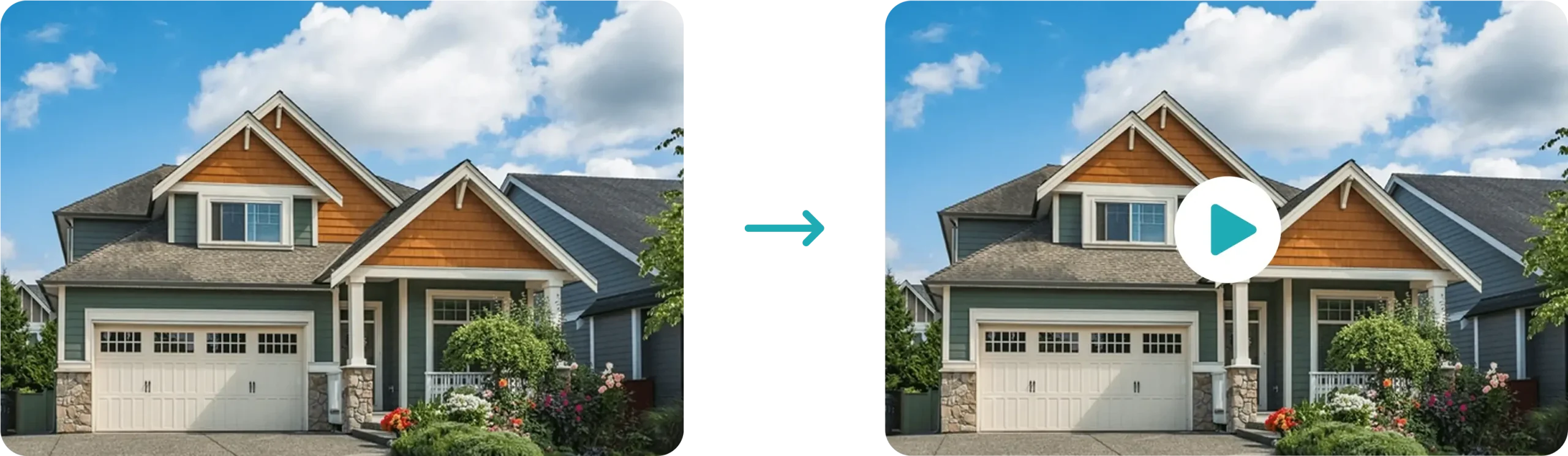
Why? Because the internet has moved on from static images. We live in the era of TikTok, Instagram Reels,
and YouTube Shorts. The social media platforms that dictate consumer attention no longer reward photo
galleries; they demand dynamic, vertical video.
But here lies the real estate agent’s greatest dilemma: Video is incredibly
expensive, time-consuming, and hard to scale.
Until now.
In this comprehensive deep dive, we are going to explore the bottleneck of
modern real estate marketing, why traditional video is failing the average listing, and how specialized AI
platforms—specifically AutoReel—are radically rewriting the rules of property marketing in 2026.
Part 1: The Bottleneck of Traditional Real Estate Media
To understand why AI video generation is such a monumental leap forward, we
first need to understand the economics of real estate media.
For a multi-million dollar luxury estate, dropping $1,500 to $5,000 on a full
production crew makes sense. You hire a drone pilot, a videographer with a Steadicam, a lighting assistant,
and a professional editor. You wait a week for the final cut, and you get a cinematic masterpiece. The
margins on a luxury commission justify the expense.
But what about the $450,000 suburban family home? What about the $300,000
downtown condo?
These properties make up the vast majority of the real estate market, yet the
math simply doesn't work for high-end video production. If an agent or a brokerage spends a week and a
thousand dollars on media for every standard listing, their profit margins vanish.
As a result, most agents resort to one of three compromises:
The "Photo-Only" Approach: Ignoring
video entirely and hoping high-quality still photos will do the job. (Spoiler: On modern social media, they
won't).
The "DIY iPhone Walkthrough": The agent
walks through the house with their phone, resulting in shaky footage, poor lighting, and zero editing.
The "Slideshow" Trap: Stitching photos
together in standard software with a slow pan and elevator music. It’s technically a video, but it lacks
soul, engagement, or scroll-stopping power.
This gap between the demand for video (driven by consumer habits) and the
cost of video (driven by traditional production realities) created a massive void in the market.
Part 2: Enter AutoReel — The AI Architect
The tech industry is flooded with generative AI tools right now. You can use
platforms like Runway or Pika to turn text into surreal, moving art. You can use CapCut for incredibly
granular video editing. But general-purpose tools require a steep learning curve. Real estate professionals
don't want to become prompt engineers or video editors; they want to sell houses.
This is where AutoReel carved out its empire. Founded by Alok Gupta, a former
product leader at tech giants like Facebook and Snapchat, AutoReel was built with a singular, hyper-focused
mission: Turn static real estate photos into professional, cinematic marketing videos in minutes, not days.
Instead of trying to be everything to everyone, AutoReel acts as an
automated, highly specialized marketing agency in your browser. It leverages advanced AI to understand the
spatial depth of a 2D photograph, applying artificial camera movements, transitions, and pacing to create
the illusion of actual video footage.
"AutoReel doesn’t try to replace Christopher Nolan. It tries to replace the
friction of everyday marketing. It gives the $400,000 listing the marketing power that used to be reserved
for the $4,000,000 listing."
The Anatomy of the Platform
What makes AutoReel stand out from generic video editors is its understanding
of industry workflow. Real estate moves fast. The platform boasts a turnaround time of roughly 10 minutes
per video, operating on a dead-simple, 4-step pipeline:
Step 1: frictionless Ingestion. You don't even need to download files from
your photographer. With a one-click import feature linked directly to Realtor.com, the AI instantly pulls
the high-res gallery of a property.
Step 2: Vibe and Branding. The user selects the orientation (Portrait for
TikTok/Reels, Landscape for YouTube). You choose the mood of the music, the style of the captions, and
upload your brokerage's logo and color palette.
Step 3: AI Generation. This is the black box where the magic happens. The
AI analyzes the photos, determines the focal points of each room (e.g., zooming in on the fireplace, panning
across the kitchen island), and stitches them together with rhythm and flow.
Step 4: The Studio Polish. For those who want more control, the AutoReel
Studio allows for quick adjustments—swapping a track, tweaking text, or adding a personal intro.
Create your AI property videos today
AutoReel helps creators, marketers, and real estate pros turn raw content
into polished, platform-ready reels in minutes.
Part 3: Beyond Motion — The Deep AI Feature Set
If AutoReel simply added a "Ken Burns" zoom effect to photos, it wouldn't be
revolutionary. What makes the platform a game-changer are the modular AI features that solve other massive
headaches for real estate professionals.
1. AI Virtual Staging: Selling the Dream
Empty houses don't sell as well as furnished ones. Buyers struggle to
visualize the scale of a room without furniture. A vacant living room looks small; an empty master bedroom
feels cold.
Traditional physical staging costs thousands of dollars per month in
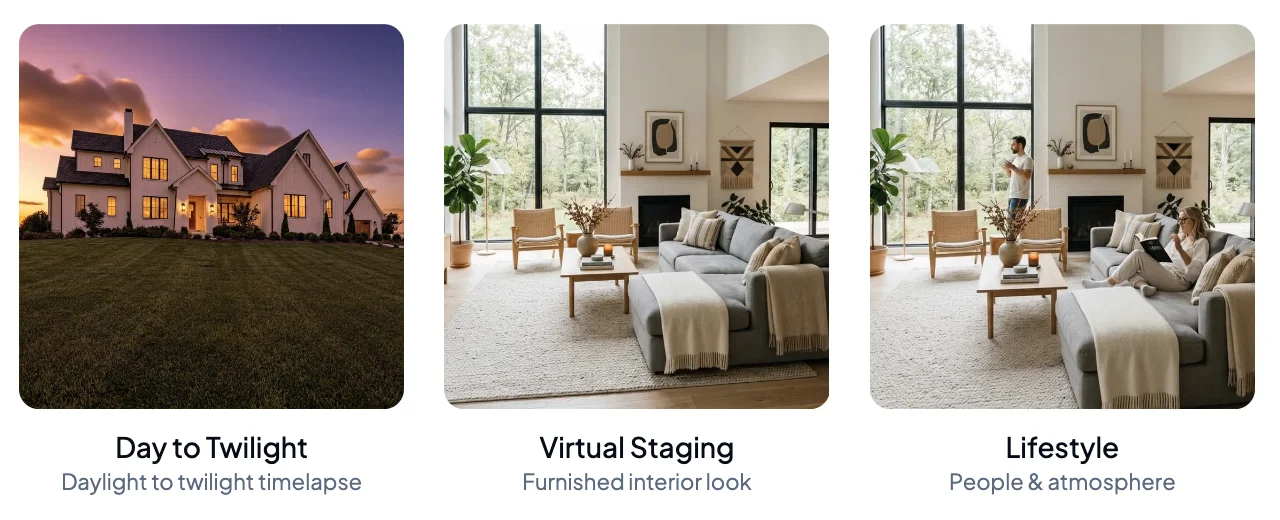
furniture rental and moving fees. AutoReel's built-in AI Virtual Staging allows an agent to take a photo of
an empty, echoey room and, with a click, populate it with stylish, photorealistic furniture. The AI
understands lighting, shadows, and perspective, ensuring the virtual couch doesn't look like a floating
sticker, but a natural part of the environment.
2. Viral Visual Effects (VFX) & Photo Edits
You shot a property on a rainy Tuesday, but you need it to look warm and
inviting.
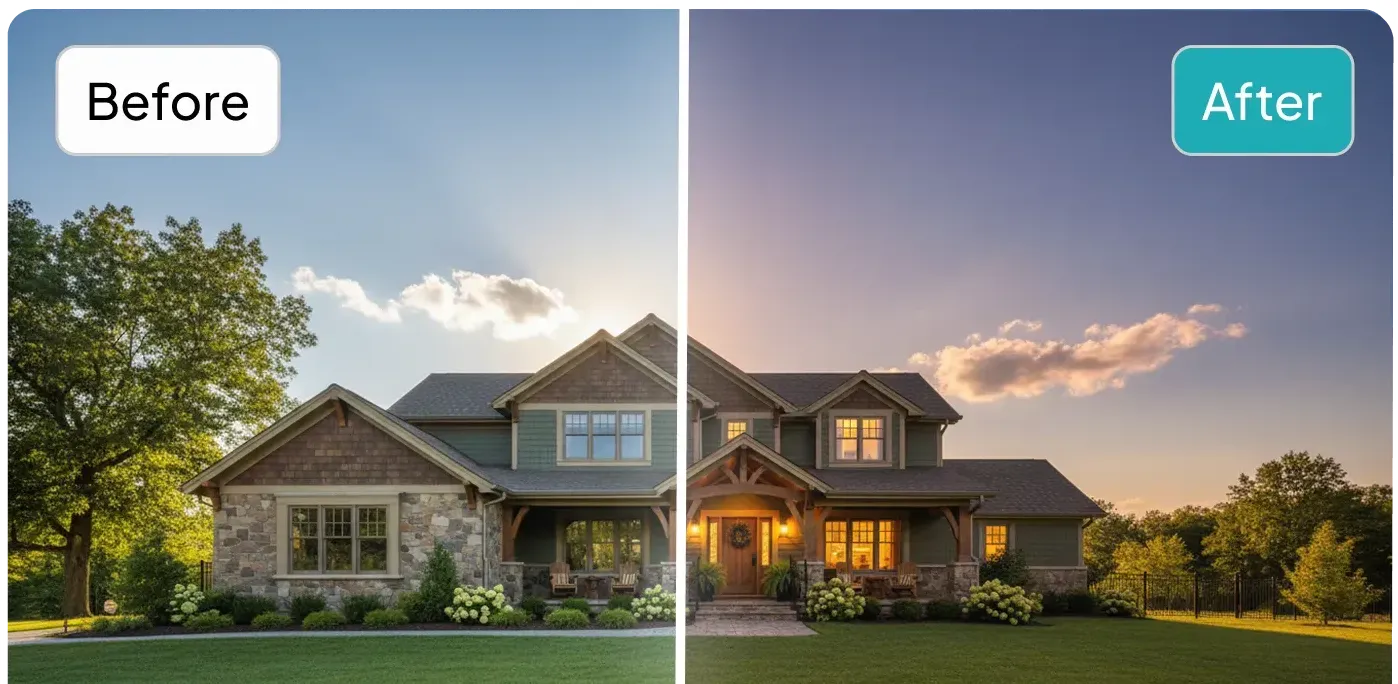
Day-to-Dusk: The AI can take a daytime
exterior shot and seamlessly transition it into a stunning twilight photo, turning on the interior lights
and painting the sky with sunset hues.
Lawn Replacement: Brown, patchy grass
in the middle of winter? The AI instantly replaces it with a lush, manicured green lawn.
3. The Virtual Agent: AI Voiceovers and Avatars
Not everyone is comfortable on camera, but human connection drives sales.
AutoReel allows users to input a script and generate a flawless, natural-sounding AI voiceover.
Even more impressively, agents can use AI Avatars. You can have a
photorealistic, professional avatar stand at the bottom of the screen, gesturing and guiding the viewer
through the property tour, adding a layer of high-end production value without the agent ever having to do
their hair and makeup or memorize a script.
Part 4: The Economic Ripple Effect
The introduction of specialized AI like this doesn't just change how videos
are made; it changes the underlying economics of three distinct groups in the real estate ecosystem.
For the Real Estate Agent
The modern agent is expected to be a market analyst, a therapist, a
negotiator, and a social media influencer. It’s an exhausting mandate. AutoReel effectively acts as a
tireless, in-house social media manager.
By dropping the cost of video creation to near-zero (aside from the software
subscription) and the time investment to 10 minutes, agents can now afford to run aggressive, video-first
marketing campaigns for every single listing in their portfolio. This uniformity builds massive brand
equity. When a potential seller looks at an agent's Instagram feed and sees that every single
listing—regardless of price point—gets premium video treatment, it becomes a powerful listing presentation
tool. “Hire me, and this is how your house will look.”
For the Real Estate Photographer
Initially, photographers feared AI. If an app can make videos out of photos,
why would agents hire videographers?
But savvy media companies realized AutoReel isn't a replacement; it's a
margin multiplier. Photographers are now using AutoReel on the backend. When an agent books a standard photo
package for $200, the photographer can click a button in AutoReel and instantly generate a social media
reel. They can then upsell this AI Reel to the agent for an extra $75.
The photographer spent zero extra minutes on-site, bought zero video
equipment, yet increased their revenue per shoot by nearly 40%. It is pure, unadulterated profit scaling.
For the Brokerage
At the enterprise level, brokerages are fighting a war for talent. Retaining
top-producing agents means providing them with the best tools. Brokerages that provide enterprise access to
AI video platforms give their agents an immediate, unfair advantage in local markets, ensuring brand
consistency across hundreds of independent contractors.
Part 5: The Skeptic's Corner — Where AI Falls Short
To be fair and objective, we must address the limitations of the current
technology. While platforms like AutoReel are incredibly powerful, they are not magic, and they have
distinct boundaries.
The Spatial Reality Problem:
AI video generated from static photos is still an illusion. It is essentially
2.5D animation. While the AI is getting incredibly good at simulating depth—making a kitchen island appear
to move at a different speed than the cabinets behind it (parallax effect)—it cannot replace the true
spatial awareness of walking through a home. It cannot show the exact layout of the hallway relative to the
master bath the way a continuous, physical video walkthrough can.
Artifacting and Hallucinations:
When using features like AI Virtual Staging or object removal, the AI can
occasionally "hallucinate." A virtual chair might have a strange shadow, or a reflection in a mirror might
not match the artificially placed furniture. While these errors are becoming rare, they still require a
human eye to quality-check the final output before publishing to thousands of potential buyers.
The Luxury Ceiling:
Will AI replace the bespoke videographer for a $15 million beachfront
mansion? Absolutely not. At the ultra-luxury tier, buyers expect emotional, cinematic storytelling complete
with lifestyle actors, drone footage over the ocean, and bespoke color grading. AI tools are the undisputed
kings of the mid-market and everyday listings, but the ultra-high-end will always demand bespoke, human-led
craftsmanship.
Part 6: The Future of Real Estate Marketing (2026 and Beyond)
As we look toward the end of the decade, the integration of AI in real estate
is only going to deepen. We are rapidly approaching a reality where static photos on an MLS are viewed as
archaic as a black-and-white newspaper classified ad.
Hyper-Personalization at Scale:
The next frontier for tools like AutoReel will be dynamic personalization.
Imagine a future where the AI generates not just one video, but three variations of the same property from
the same photos.
Video A is tailored for families, emphasizing the backyard, the school
district, and the spacious bedrooms.
Video B is tailored for young professionals, highlighting the home office,
the modern kitchen, and the proximity to downtown nightlife.
Video C is optimized specifically for TikTok algorithms, using trending audio
and fast-paced jump cuts.
All generated in 10 minutes, allowing the agent to run highly targeted
micro-ad campaigns.
The Democratization of Quality:
Ultimately, what AI does best is raise the baseline of quality for everyone.
It democratizes high-end marketing. A solo agent working out of their car in Ohio now has access to the same
caliber of visual marketing tech as a 50-person brokerage in Beverly Hills.
Final Thoughts: The Adaptability Imperative
The real estate industry has historically been slow to adopt new technology,
clinging to open houses, direct mailers, and cold calling long after consumer attention shifted online. But
the shift to short-form video is not a fad; it is a fundamental rewiring of how humans consume information.
Platforms like AutoReel have removed the last remaining excuses for not
executing a video-first marketing strategy. The barriers of cost, time, and technical skill have been
completely obliterated.
For real estate professionals in 2026, the question is no longer if they
should use AI to market their properties. The question is how quickly they can adopt it before their
competitors do. In a market where attention is the most valuable currency, static photos are a whisper, but
dynamic AI video is a megaphone.